
Just A Click Away.
Based on publicly available information and industry observations as at mid-January 2026
Over the past week, one question has been popping up again and again in student and parent communities:
“Is Australia starting to crack down on certain countries?”
Some describe it as Australia “blacklisting Asia”.
Others point specifically to India.
And with the recent Bondi incident still fresh in public discussion, it’s easy to see why anxiety has escalated so quickly.
But if we move past headlines and screenshots, what’s actually happening is not a blanket shutdown, nor a sudden policy reversal — it’s a technical but significant shift in how student visas are assessed.
This article isn’t about dismissing concerns.
It’s about unpacking what has changed — and what hasn’t.
1. Have student visa risk levels actually been raised?
Yes — this part is real.
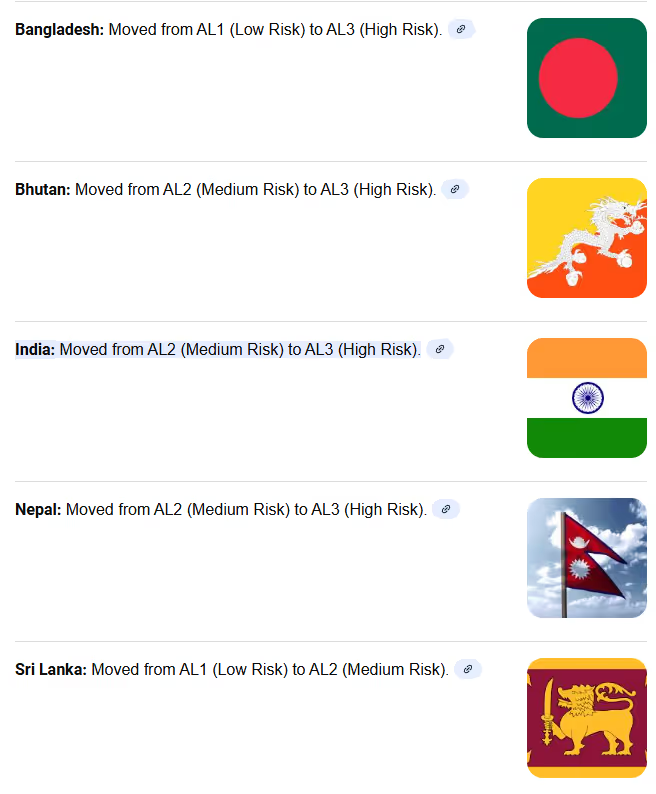
From 8 January 2026, Australia’s student visa system adjusted the Assessment / Evidence Levels for certain source countries.
Based on current industry guidance and institutional feedback (with the important caveat that final requirements always depend on the visa system at the time of application):
- From 8 January 2026, Home Affairs has shifted India, Nepal, Bangladesh and Bhutan into the highest evidence setting (often referred to as Level 3) for many common study profiles, according to current sector guidance.
- Sri Lanka
- → generally remains at Level 2
- Some other source countries
- → may also attract higher evidence requirements depending on the institution and course
It’s important to clarify one thing upfront:
There is no official “blacklist” published by Home Affairs.
Assessment Levels are applied dynamically, based on a combination of country of origin, education provider and course profile, rather than nationality alone.
2. So where does the “tightening” actually show up?
A common reaction has been:
“Does this mean student visas are basically closed now?”
In practice, that’s not what’s happening.
What is happening is that poorly documented or weakly justified applications from any country are finding it much harder to get through.
From an operational perspective, the changes are most noticeable in three areas:
- Financial evidence is examined more closely
- Bank statements, source of funds and consistency now carry greater weight
- Document authenticity checks have increased
- Qualifications, transcripts and English results are scrutinised more carefully, especially where inconsistencies appear
- Genuine student intent matters more than before
- Why this course? Why this institution? How does it connect to the applicant’s background and plans?
Put simply:
student visas are being pushed back towards their original purpose — study first, not entry by default.
3. Is this linked to broader social and political pressure?
This is a question many people are quietly asking.
Looking at the timing, it’s hard to ignore the wider backdrop:
- Ongoing public concern around housing, infrastructure and population growth
- Heightened attention on visa integrity and screening following recent security-related incidents
- A broader policy shift away from volume-driven migration and towards risk-managed systems
That said, it’s important to be precise:
These factors are not direct legal triggers for the student visa changes.
However, they do form the environment in which integrity, compliance and risk management have become politically and administratively more sensitive.
4. Is this “targeting” certain nationalities?
From a legal and policy design perspective, the answer is clear:
The system is designed to target risk indicators in applications — not people or passports.
That said, from an applicant’s lived experience, there’s no denying that:
- Applicants from higher-risk source countries face higher evidentiary thresholds
- Requests for additional documents and closer scrutiny are more common
- The same course can feel very different to apply for, depending on background
This is why many applicants understandably feel singled out — even though, in formal design, the framework is built around risk profiling rather than explicit nationality bans.
Both realities can exist at the same time.
5. What does this mean for genuine students with long-term plans?
In short:
The door isn’t closed — but the shortcuts are.
For genuine students, this shift mainly means:
- Preparing earlier and more thoroughly
- Presenting a clear, consistent study narrative
- Choosing courses that make sense in light of prior education and career direction
At the same time, Australia’s broader migration settings for 2025–2026 continue to emphasise quality over quantity, with skilled and productive migration still firmly at the centre of long-term policy.
Student visas remain part of that ecosystem — just with fewer tolerances for misuse.
A final, practical observation
Rather than viewing this as Australia “turning hostile”, it may be more accurate to say:
Australia is no longer willing to absorb the cost of parts of the system being misused or exploited.
The real risk for applicants today isn’t the policy itself —
it’s underestimating how much the assessment environment has changed.
For anyone with complex education histories, funding structures or future migration plans, relying on generic advice or recycled templates carries more risk than ever.
This article is general information only and does not constitute legal advice.
Outcomes depend heavily on individual circumstances.
📅 Book a Consultation: https://calendly.com/getprfaster
💼 Speak with a Migration Lawyer: enquiry@riverwoodmigration.com
💬 Chat with Johnny: https://linktr.ee/johnny_lawyer