

Just A Click Away.
Four days of work, full pay — a new possibility is being tested
Imagine this—
Starting next month, you only work four days a week.
Fridays are completely yours.
No hidden overtime.
Your income stays exactly the same.
It sounds like a dream.
But in Australia in 2026, this idea has already moved into a very real, practical phase.
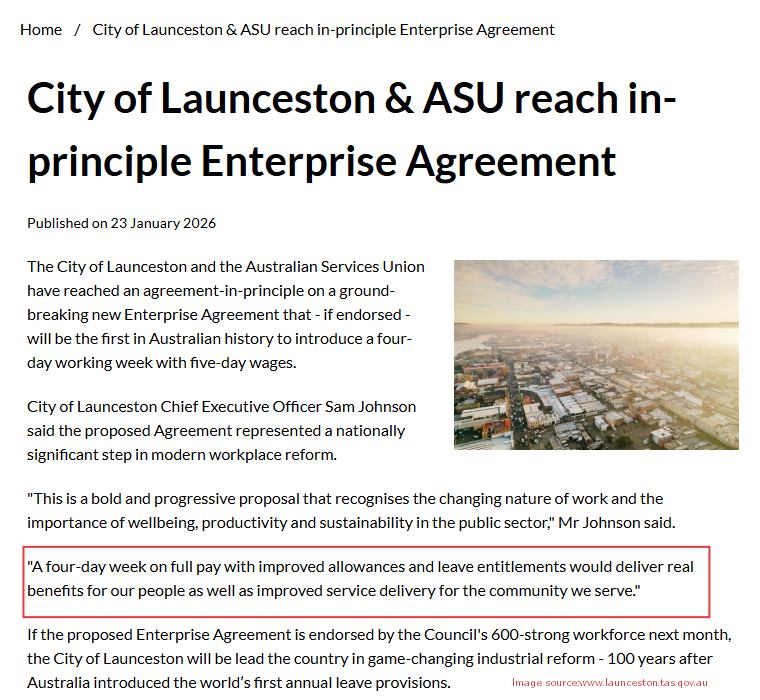
Recently, the Launceston City Council in Tasmania reached an in-principle agreement with the union.
If approved by staff through a vote and endorsed by the Fair Work Commission, Launceston could become Australia’s first local government to implement a full-pay four-day work week.
The news sparked strong reactions — especially among Chinese Australians.
Because this is not just a change in working hours, but a quiet test of a different philosophy of life.
01 What does a four-day work week actually mean?
Described in official statements as “bold and progressive”, the agreement includes:
- Adjusted hours: Full-time staff work 30.4 hours per week, spread across four days
- No pay cut: 100% of the original five-day salary
- Who it applies to: Around 600 council employees (excluding senior executives), covering both office-based and outdoor roles
The council’s CEO stated openly that for many roles,
the traditional five-day work model no longer fully aligns with the pace of modern life.
Here, the idea that “work exists to support life, not replace it” is being taken seriously.
02 There is no perfect option — but many are willing to trade
Of course, change comes with trade-offs:
- Lower wage growth over the next two years (around 1% per year)
- Superannuation contributions reduced back to the statutory minimum
But if you do the time calculation:
limited wage growth in exchange for 50+ extra full days off each year.
For many people, control over their time is more valuable than marginal income increases.
03 Two perspectives, one reality: why people choose Australia
Xiaolin, 28, previously worked in China’s tech sector under intense pressure.
After moving to Australia, weekends were protected — but life still revolved around the work calendar.
When he saw the news, he laughed and said:
“This is exactly why I chose Australia — here, time can actually belong to you.”
Another voice comes from Lao Wang, a local restaurant owner, who raised practical concerns:
Will council services slow down?
If employees across industries start requesting four-day weeks, how will small businesses cope?
These contrasting views reflect the reality of social transition:
there is no overnight solution — only ongoing attempts to find balance.
04 What matters more is the value discussion behind it
The four-day work week is not an isolated idea.
It sits within a broader social conversation:
- Does productivity really equal hours worked?
- Can proper rest become a source of long-term productivity?
- Can a person’s value exist beyond their job title?
History offers parallels.
As early as 1856, Melbourne was home to one of the world’s first eight-hour work day movements.
At the time, many feared economic damage — but history showed that progress often includes allowing people to live with greater ease and dignity.
05 When you consider migration, what are you really choosing?
This story resonates because it quietly asks a deeper question:
Migration is not just about changing location —it’s about choosing a way of life you genuinely believe in.
If you often feel that:
- Work keeps consuming your life with no clear boundary
- You’re exhausted by a culture that measures contribution purely by hours
- You want your family to grow up in an environment that values balance
Then what you’re thinking about may not just be “Can I migrate?”
But rather — is it worth redesigning my life for a different possibility?
06 Life isn’t somewhere else — it’s in the direction you choose
The Launceston trial is still unfolding.
But the signal it sends is already clear:
For many people in Australia, life does not have to be the background noise of work.
Change won’t happen overnight — but exploration has begun.
And perhaps the deeper reason we work hard will eventually return to this:
So that we can experience life more fully.
If “full pay, four days a week” became an option,
how would you weigh income against time?
And if you’re starting to imagine a different rhythm of life,
this story may be a moment to reflect —
not to escape, but to choose more consciously.
📅 Book a Consultation: www.riverwoodmigration.com/book-a-consultation
💼 Speak with a Migration Lawyer: enquiry@riverwoodmigration.com
💬 Chat with Johnny: https://linktr.ee/johnny_lawyer
.avif)
.avif)