
Just A Click Away.
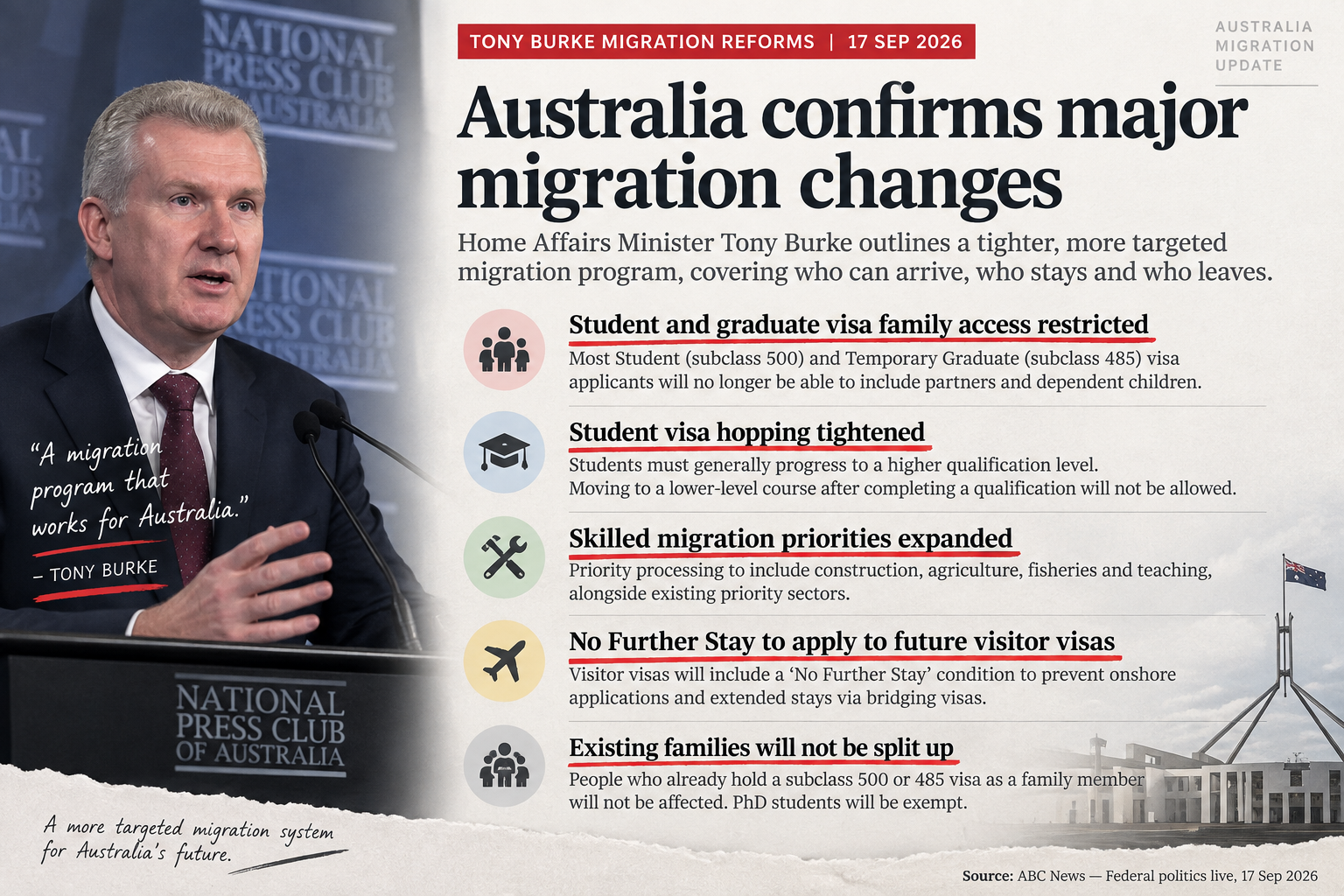
Australia has officially confirmed a major package of migration reforms, with changes affecting international students, graduates, skilled migrants, visitors and working holiday makers.
Home Affairs Minister Tony Burke confirmed the reforms during his National Press Club address on 17 September 2026, outlining a broader push to strengthen Australia's migration system and determine more clearly who can arrive, stay and transition between visas.
For current and prospective visa holders, the key message is that these changes have moved beyond speculation.
However, the Government has not yet confirmed commencement dates for several of the measures, meaning the policy direction is clear but important implementation and transitional details are still to come.
Here is what we know so far.
Student and Graduate Visa Dependants to Be Restricted
One of the most significant changes affects international students and Temporary Graduate visa holders.
The Government has confirmed that most Student visa (Subclass 500) and Temporary Graduate visa (Subclass 485) applicants will no longer be able to include partners and dependent children as secondary applicants under the new arrangements.
There are two important points for existing visa holders.
People who already hold a Subclass 500 or 485 visa as a secondary applicant will not be affected by this change, while PhD students will be exempt from the new restriction.
The Government has framed the reform as part of a broader effort to control growth in temporary migration and reconsider how quickly temporary migrants can bring family members to Australia.
For couples and families currently considering a study or graduate visa pathway, family strategy may therefore become a much more important part of migration planning.
Australia Is Tightening Student Visa “Visa Hopping”
The Government has also confirmed tougher rules targeting “visa hopping” within the international education system.
The reform is aimed at people who complete a qualification and then enrol in another course at the same or a lower level primarily to extend their stay in Australia.
Under the new direction, students will generally be expected to demonstrate genuine upward academic progression rather than moving backwards through lower-level qualifications.
Importantly, legitimate circumstances such as extending study because of illness or failed subjects, or changing courses at the same level within the same institution, are not being treated as visa hopping.
This distinction matters.
The policy is targeting the use of repeated study as a way of prolonging a person's stay — not ordinary academic circumstances faced by genuine students.
Major Positive Change for Housing Trades
Not every part of the announcement involves tighter restrictions.
One of the most significant opportunities is the proposed reform of Australia's skilled migration points system.
The Government has confirmed that housing trade qualifications will receive the same points recognition as university qualifications under the reformed points test.
This could be particularly significant for qualified tradespeople and people considering career pathways in areas such as construction and electrical trades.
Australia continues to face substantial demand for workers who can contribute to housing construction, and the Government is increasingly aligning the migration system with these workforce needs.
For skilled workers with relevant trade qualifications, the reform could materially change how competitive their profile is under Australia's points-tested skilled migration system.
More Industries to Receive Skilled Visa Processing Priority
Australia is also expanding priority processing across key skilled industries.
Under changes associated with Ministerial Direction 119, priority sectors will include established areas such as:
- health;
- construction;
- education;
- law enforcement; and
- defence.
The priority framework is also being expanded to include resources, agriculture, aquaculture and fisheries.
This reinforces a broader shift in Australia's skilled migration strategy: migration places and processing resources are increasingly being directed towards occupations that address identified workforce and economic needs.
For skilled migrants — including current temporary visa holders considering longer-term options — occupation, industry and pathway selection may become increasingly important.
Visitor Visas to Face “No Further Stay” Restrictions
The Government has also announced a significant tightening of Visitor visa arrangements.
Visitor visas will be subject to a No Further Stay condition, designed to prevent people from entering Australia as visitors and then using onshore applications and bridging visas to remain in the country for extended periods.
The Government has specifically linked this measure to fairness within Australia's family migration program.
The concern is that some applicants can currently enter Australia on a Visitor visa, lodge another visa application onshore and remain on a bridging visa, while applicants following an offshore family migration pathway may wait overseas for significantly longer periods.
For people considering entering Australia on a Visitor visa while also planning another visa pathway, professional advice on timing and visa conditions will become increasingly important.
Working Holiday Visa Rules Are Also Changing
Second and third-year Working Holiday Maker arrangements are also set to change.
The Government has confirmed plans to introduce a ballot system for subsequent Working Holiday visas, together with regional work requirements designed to continue supporting regional Australia.
The Government is also seeking to bring Working Holiday visa processing times to around three months.
While this measure is less relevant to many existing skilled and student visa holders, it forms part of the same broader reform agenda: tighter control over temporary migration while directing migrants towards areas of economic need.
What About 482 Visa Holders and Skilled Migrants?
For current Skills in Demand (Subclass 482) visa holders and applicants considering skilled pathways such as the 189, 190 or 491 visas, it is important not to overinterpret the announcement.
The Government has not announced that the new restrictions on secondary applicants will apply to skilled visa applicants generally.
There has also been no announcement that skilled visa applicants will lose the ability to include family members simply because restrictions are being introduced for Student and Temporary Graduate visas.
At the same time, changes to processing priorities and the skilled migration points test could create new considerations — and potentially new opportunities — for some skilled workers.
Individual circumstances, occupation, qualifications, current visa status and longer-term migration objectives will all matter.
When Will the New Migration Rules Take Effect?
This is currently the biggest unanswered question.
Although the Government has officially confirmed the policy changes, specific commencement dates have not yet been announced for several of the reforms.
Further legislation, legislative instruments and Department of Home Affairs guidance are expected to provide details on:
When each change takes effect;
how applications already lodged will be treated;
what transitional arrangements will apply; and
whether additional exemptions will be available.
Until those details are released, it is important to distinguish between a confirmed policy change and a rule that has already commenced.
What Should Current Visa Holders Do?
The migration landscape has now moved from speculation to confirmed policy change.
For Student and Temporary Graduate visa applicants in particular, the restrictions around secondary applicants could materially affect how couples and families plan their Australian migration pathway.
At the same time, skilled workers — particularly those with housing and trade qualifications — may find that the changes create new opportunities under Australia's increasingly targeted skilled migration program.
The appropriate response will depend on your current visa, family circumstances, qualifications, occupation and long-term objectives.
If you currently hold a Subclass 482, 485 or 500 visa, or are planning to apply for an Australian visa in the near future, now is a sensible time to have your circumstances professionally assessed rather than waiting until the implementation rules are released.
Understanding whether the reforms affect you — and what options remain available before commencement — may make a significant difference to your migration planning.
The content of this article is intended for general informational purposes only and does not constitute legal advice. Immigration law is complex and subject to change. The information provided may not reflect the most current legal developments. For advice specific to your circumstances, please consult a registered Australian migration lawyer. For full terms governing use of this website and its content, please refer to our Website Terms and Conditions.
Speak with a Riverwood Migration Lawyer
As a regulated Australian migration law practice, Riverwood Migration provides precise, personalised advice on visa strategy, compliance, and application preparation. Speak with our expert legal team. Book a consultation to discuss your circumstances.
Stay Informed on Australian Immigration Law
- YouTube: Johnny Kong | Migration Lawyer
- Instagram: @johnny_migrationlawyer
- Facebook: Riverwood Migration
- TikTok: @johnny_migrationlawyer
- Linktree: linktr.ee/johnny_lawyer