
Just A Click Away.
The Migration Institute of Australia reported updated processing timeframes for Working Holiday Maker visa applications in MIA Notice 4, issued on 17 July 2026.
The Working Holiday Maker program includes the Subclass 417 Working Holiday visa and the Subclass 462 Work and Holiday visa. Both visas allow eligible young people from participating countries to live, work and travel in Australia, generally for up to 12 months.
However, the eligibility requirements and processing timeframes differ between the two visa subclasses. Applicants should check the requirements applying to their passport nationality before making travel or employment plans.
Current Processing Timeframes
According to the indicative timeframes reported in MIA Notice 4 on 17 July 2026:
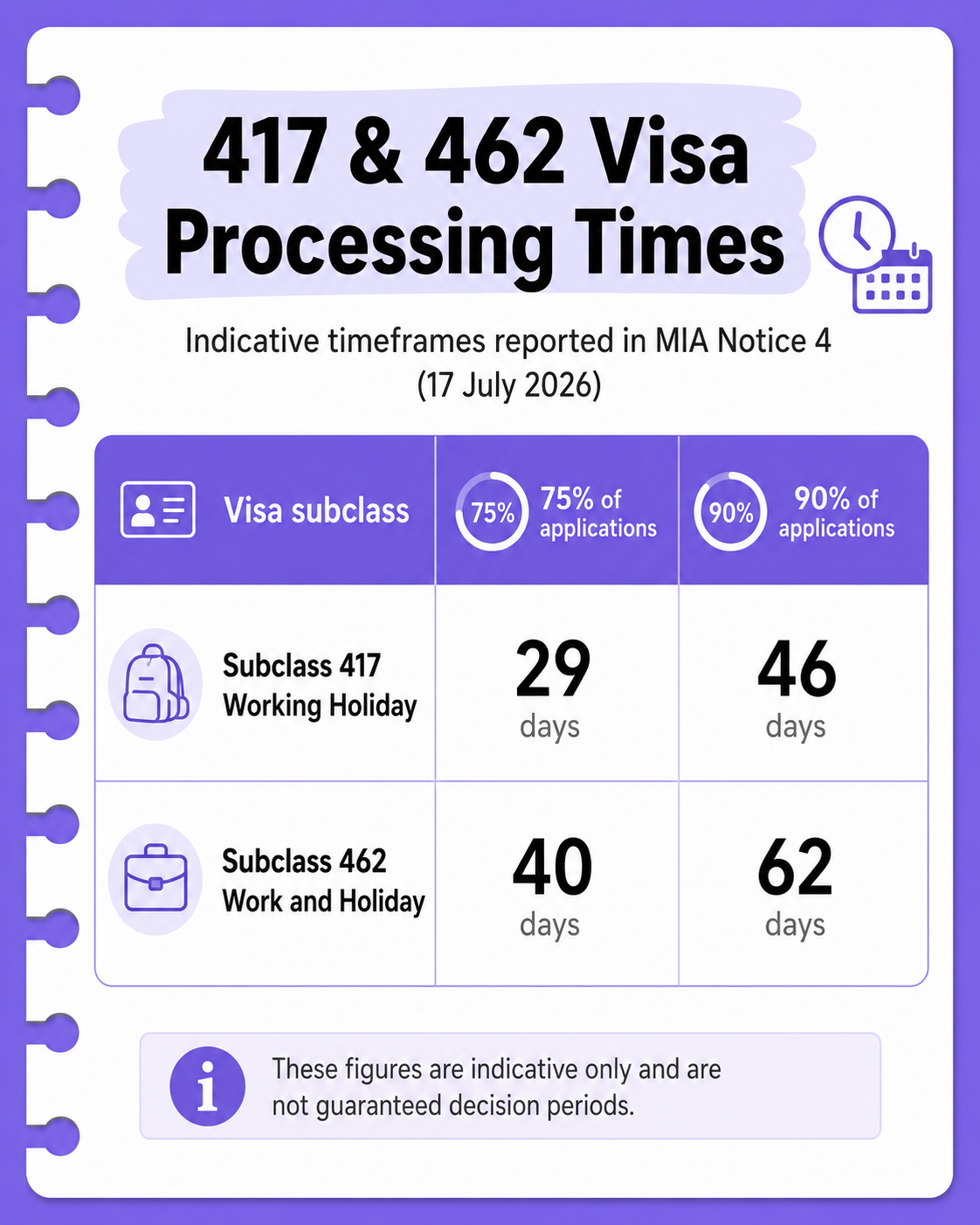
These figures are indicative only and reflect the processing position reported at that time. They are not guaranteed decision periods.
An application may take longer if further information is required, documents are incomplete, health or character checks are needed, or application volumes increase.
Applicants should avoid making non-refundable travel arrangements until their visa has been granted.
What Is the Difference Between the 417 and 462 Visas?
The Subclass 417 Working Holiday visa is available to passport holders from participating countries and regions, including the United Kingdom, Germany, France, Italy, Japan, South Korea and Taiwan.
The Subclass 462 Work and Holiday visa is available to passport holders from a different group of participating countries, including the United States, China, Vietnam, Thailand and Argentina.
Subclass 462 requirements vary depending on the applicant’s passport country. Depending on nationality, an applicant may need to meet education and English-language requirements, obtain a government support letter or complete a visa ballot process before lodging an application.
Applicants should not assume that the requirements applying to one country also apply to another.
First, Second and Third Working Holiday Maker Visas
Eligible applicants may be able to apply for a second or third Working Holiday Maker visa.
Where specified work is required, applicants must complete eligible work in an approved industry and location during the relevant visa period. The required period of specified work generally differs between second and third visa applications.
Applicants should retain clear evidence of their work, which may include:
- Payslips
- Bank statements showing salary payments
- Employment contracts
- Tax and superannuation records
- Employer details
- Timesheets or rosters
Not every applicant is subject to the same specified work requirements. For example, eligible UK passport holders may apply for a second or third Subclass 417 visa without completing specified work under the current arrangements.
Applicants should confirm the rules applying to their nationality and visa history before lodging.
Applying from Inside Australia
Some applicants may be eligible to lodge a second or third Working Holiday Maker visa application while in Australia and may receive a Bridging Visa while waiting for a decision.
However, Bridging Visa work rights are not automatically the same in every case. Applicants should check their individual Bridging Visa grant notice or VEVO record before starting or continuing employment.
A Bridging Visa may also remain inactive while the applicant’s current substantive visa is still in effect.
Applicants should not assume they have unrestricted work rights simply because a Working Holiday Maker application has been lodged.
Documents Applicants May Need
The documents required depend on the visa subclass, passport nationality and individual circumstances.
Applicants may be asked to provide:
- Evidence of sufficient funds
- Education or English-language evidence
- A government support letter
- Evidence of specified work
- Health examinations
- Police clearances
- Additional identity or character documents
Health examinations and police certificates are not required from every applicant. Applicants should follow the requirements shown in their ImmiAccount and respond promptly to any request from the Department of Home Affairs.
Appropriate travel and health insurance should also be considered before travelling to Australia.
Practical Steps Before Applying
Before lodging a Working Holiday Maker visa application, applicants should:
- Confirm whether their passport is eligible for Subclass 417 or Subclass 462.
- Check the applicable age limit and nationality-specific requirements.
- Confirm whether a ballot, government support letter, English test or education evidence is required.
- Prepare complete and consistent supporting documents.
- Keep evidence of specified work where that requirement applies.
- Lodge well before the intended travel date.
- Monitor ImmiAccount for requests for further information.
- Avoid booking non-refundable travel until the visa is granted.
As a conservative planning measure, applicants may wish to allow approximately 60 to 90 days before their intended travel date. However, some applications may be decided sooner or take longer depending on the individual circumstances.
Key Takeaways
MIA Notice 4, issued on 17 July 2026, reported indicative processing timeframes of:
- 29 to 46 days for Subclass 417
- 40 to 62 days for Subclass 462
These timeframes are not guarantees and may change as application volumes and departmental priorities change.
Subclass 417 and Subclass 462 applicants are also subject to different nationality, age, education, English-language and supporting-document requirements.
Applicants planning a second or third Working Holiday Maker visa should confirm whether specified work is required in their circumstances and prepare clear evidence before lodging.
Careful preparation cannot guarantee a faster decision, but it can reduce the risk of delays caused by incomplete documents, inconsistent information or requests for further evidence.
The content of this article is intended for general informational purposes only and does not constitute legal advice. Immigration law is complex and subject to change. The information provided may not reflect the most current legal developments. For advice specific to your circumstances, please consult a registered Australian migration lawyer. For full terms governing use of this website and its content, please refer to our Website Terms and Conditions.
Speak with a Riverwood Migration Lawyer
As a regulated Australian migration law practice, Riverwood Migration provides precise, personalised advice on visa strategy, compliance, and application preparation. Speak with our expert legal team. Book a consultation to discuss your circumstances.
Stay Informed on Australian Immigration Law
- YouTube: Johnny Kong | Migration Lawyer
- Instagram: @johnny_migrationlawyer
- Facebook: Riverwood Migration
- TikTok: @johnny_migrationlawyer
- Linktree: linktr.ee/johnny_lawyer